
🇩🇪 Deutsch
Wenn Prinzipien nicht mehr reichen – wo Governance wirklich beginnt
In den letzten Jahren sind zahlreiche Initiativen entstanden, die versuchen, künstliche Intelligenz ethisch zu rahmen. Sie formulieren Prinzipien, Leitlinien und Werte: Transparenz, Fairness, Verantwortung.
Diese Arbeit ist wichtig. Sie schafft Orientierung.
Doch genau hier beginnt ein Problem, das bislang kaum adressiert wird:
👉 Prinzipien beschreiben, was gelten soll – aber nicht, wann es tatsächlich wirksam wird.
Die stille Lücke zwischen Idee und Wirkung
Ein System kann:
- Regeln enthalten
- ethische Leitlinien berücksichtigen
- Entscheidungen logisch konsistent treffen
Und dennoch bleibt eine zentrale Frage offen:
👉 Wann wird aus einer Entscheidung eine reale Konsequenz?
Diese Frage ist nicht theoretisch. Sie ist strukturell.
Denn zwischen:
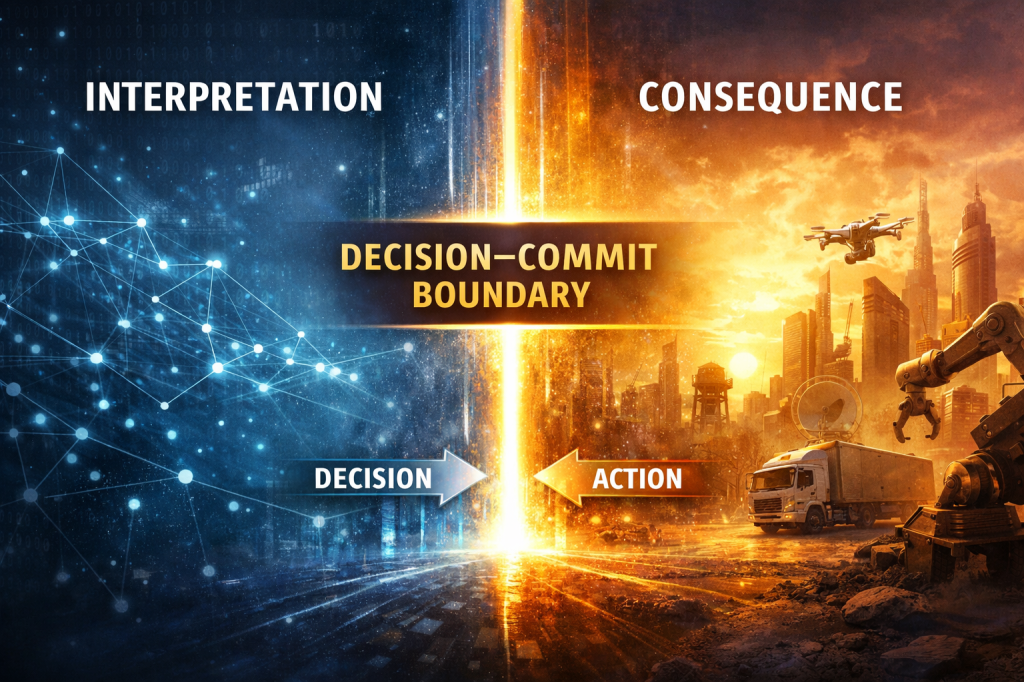
Interpretation (das System „versteht“ etwas)
und
Konsequenz (etwas passiert in der Welt)
liegt ein Moment, der oft unsichtbar bleibt.
Der Punkt, an dem Governance real wird
Wir nennen diesen Moment:
👉 die Grenze zwischen Entscheidung und Bindung
(Decision–Commit Boundary)
Hier geschieht etwas Entscheidendes:
- Ein Vorschlag wird zur Handlung
- Eine Berechnung wird zur Konsequenz
- Eine Möglichkeit wird Realität
Und genau hier entscheidet sich, ob Governance tatsächlich wirkt – oder nur beschrieben wird.
Warum Prinzipien allein nicht ausreichen
Ein Prinzip kann sagen:
👉 „Systeme sollen verantwortungsvoll handeln.“
Doch ohne eine strukturierte Grenze bleibt offen:
- Wer prüft den Moment der Umsetzung?
- Unter welchen Bedingungen wird gehandelt?
- Wann wird ein Ergebnis verbindlich?
Das Ergebnis:
👉 Systeme können formal korrekt bleiben, während die eigentliche Bindung im Hintergrund geschieht.
Von Ethik zu Architektur
Die entscheidende Verschiebung lautet:
👉 Governance ist nicht nur eine Frage der Werte – sondern der Struktur.
Das bedeutet:
- Nicht nur was erlaubt ist
- sondern wann und wie etwas wirksam wird
Diese Struktur entsteht an der Grenze selbst.
Die fehlende Dimension: der Moment
Viele Modelle denken in Zuständen, Prozessen oder Regeln.
Was oft fehlt, ist:
👉 der Moment, in dem sich alles entscheidet
Ein System kann:
- korrekt arbeiten
- stabil bleiben
- logisch konsistent sein
Und dennoch:
👉 eine Konsequenz erzeugen, ohne dass dieser Übergang sichtbar oder überprüfbar ist.
Was sich jetzt verändert
Mit zunehmender Autonomie von Systemen verschiebt sich das Problem:
👉 Die Grenze verschwindet nicht.
👉 Sie wird unsichtbarer.
Das bedeutet:
- Entscheidungen entstehen kontinuierlich
- Übergänge werden fließend
- Verantwortung wird schwieriger zu verorten
Die eigentliche Frage unserer Zeit
Nicht mehr:
👉 „Hat das System gute Prinzipien?“
Sondern:
👉 „Ist der Moment der Bindung sichtbar, prüfbar und strukturiert?“
Ausblick
Die nächste Phase der KI-Governance beginnt nicht bei neuen Regeln.
Sie beginnt hier:
👉 an der Grenze, an der Möglichkeit zur Realität wird
Denn erst dort entscheidet sich, ob Systeme nicht nur korrekt funktionieren – sondern verantwortungsvoll handeln.
🇵🇱 Polski
Kiedy zasady przestają wystarczać – gdzie naprawdę zaczyna się governance
W ostatnich latach powstało wiele inicjatyw, które próbują nadać sztucznej inteligencji ramy etyczne. Formułują zasady, wytyczne i wartości: przejrzystość, sprawiedliwość, odpowiedzialność.
Ta praca jest ważna. Tworzy orientację.
Ale właśnie tutaj zaczyna się problem, który do tej pory rzadko jest jasno nazwany:
👉 Zasady opisują, co powinno obowiązywać – ale nie określają, kiedy faktycznie zaczyna działać.
Cicha luka między ideą a skutkiem
System może:
- zawierać reguły
- uwzględniać zasady etyczne
- podejmować decyzje logicznie spójne
A mimo to pozostaje otwarte jedno kluczowe pytanie:
👉 Kiedy decyzja staje się realną konsekwencją?
To pytanie nie jest teoretyczne. Ma charakter strukturalny.
Bo pomiędzy:
interpretacją (system „rozumie”)
a
konsekwencją (coś dzieje się w świecie)
istnieje moment, który często pozostaje niewidoczny.
Punkt, w którym governance staje się realne
Ten moment nazywamy:
👉 granicą między decyzją a zobowiązaniem
(Decision–Commit Boundary)
To właśnie tutaj dzieje się coś kluczowego:
- propozycja staje się działaniem
- obliczenie staje się konsekwencją
- możliwość staje się rzeczywistością
I właśnie tutaj rozstrzyga się, czy governance rzeczywiście działa – czy tylko jest opisywane.
Dlaczego same zasady nie wystarczają
Zasada może mówić:
👉 „Systemy powinny działać odpowiedzialnie.”
Ale bez wyraźnie zdefiniowanej granicy pozostają pytania:
- Kto weryfikuje moment wykonania?
- W jakich warunkach następuje działanie?
- Kiedy wynik staje się wiążący?
Efekt:
👉 System może pozostać formalnie poprawny, podczas gdy moment zobowiązania zachodzi w tle.
Od etyki do architektury
Kluczowa zmiana brzmi:
👉 Governance to nie tylko kwestia wartości – ale struktury.
To oznacza:
- nie tylko co jest dozwolone
- ale kiedy i jak coś staje się skuteczne
Ta struktura powstaje właśnie na granicy.
Brakujący wymiar: moment
Wiele modeli myśli w kategoriach stanów, procesów lub reguł.
To, czego często brakuje, to:
👉 moment, w którym wszystko się rozstrzyga
System może:
- działać poprawnie
- pozostawać stabilny
- być logicznie spójny
A mimo to:
👉 generować konsekwencje, bez tego, by przejście było widoczne lub kontrolowane.
Co się teraz zmienia
Wraz ze wzrostem autonomii systemów zmienia się charakter problemu:
👉 Granica nie znika.
👉 Staje się mniej widoczna.
To oznacza:
- decyzje powstają w sposób ciągły
- przejścia stają się płynne
- odpowiedzialność trudniej uchwycić
Najważniejsze pytanie naszych czasów
Nie:
👉 „Czy system ma dobre zasady?”
Ale:
👉 „Czy moment zobowiązania jest widoczny, sprawdzalny i ustrukturyzowany?”
Perspektywa
Kolejna faza governance AI nie zaczyna się od nowych zasad.
Zaczyna się tutaj:
👉 na granicy, gdzie możliwość staje się rzeczywistością
Bo dopiero tam rozstrzyga się, czy systemy nie tylko działają poprawnie – ale działają odpowiedzialnie.
🇬🇧 English
When principles are no longer enough – where governance truly begins
In recent years, numerous initiatives have emerged aiming to frame artificial intelligence ethically. They formulate principles, guidelines, and values: transparency, fairness, responsibility.
This work is important. It provides orientation.
But this is precisely where a problem begins that has rarely been clearly addressed so far:
👉 Principles describe what should apply – but not when they actually become effective.
The silent gap between idea and consequence
A system can:
- contain rules
- incorporate ethical guidelines
- make logically consistent decisions
And still, one crucial question remains:
👉 When does a decision become a real-world consequence?
This question is not theoretical. It is structural.
Because between:
interpretation (the system “understands”)
and
consequence (something happens in the world)
there is a moment that often remains invisible.
The point where governance becomes real
We call this moment:
👉 the boundary between decision and commitment
(Decision–Commit Boundary)
This is where something decisive happens:
- a proposal becomes an action
- a computation becomes a consequence
- a possibility becomes reality
And it is precisely here that it is decided whether governance actually works – or is merely described.
Why principles alone are not sufficient
A principle may state:
👉 “Systems should act responsibly.”
But without a structured boundary, key questions remain:
- Who verifies the moment of execution?
- Under which conditions does action occur?
- When does an outcome become binding?
The result:
👉 Systems can remain formally correct, while the actual commitment happens in the background.
From ethics to architecture
The crucial shift is:
👉 Governance is not only a question of values – but of structure.
This means:
- not only what is allowed
- but when and how something becomes effective
This structure emerges at the boundary itself.
The missing dimension: the moment
Many models think in terms of states, processes, or rules.
What is often missing is:
👉 the moment where everything is decided
A system can:
- function correctly
- remain stable
- be logically consistent
And still:
👉 produce consequences without that transition being visible or controlled.
What is changing now
As system autonomy increases, the nature of the problem shifts:
👉 The boundary does not disappear.
👉 It becomes less visible.
This means:
- decisions emerge continuously
- transitions become fluid
- responsibility becomes harder to locate
The key question of our time
Not:
👉 “Does the system have good principles?”
But:
👉 “Is the moment of commitment visible, verifiable, and structured?”
Outlook
The next phase of AI governance does not begin with new rules.
It begins here:
👉 at the boundary where possibility becomes reality
Because only there it is decided whether systems not only function correctly – but act responsibly.





Hinterlasse einen Kommentar