
🇩🇪 Deutsch
Der Verlust der neutralen Rückkehr – Was sich verändert, bevor etwas passiert
Etwas hat sich verschoben
Nicht in der Ausführung.
Nicht im Ergebnis.
Nicht einmal in der Irreversibilität.
Früher.
In vielen KI-vermittelten Entscheidungsprozessen liegt der entscheidende Übergang nicht dort, wo etwas geschieht – sondern dort, wo sich die Fortsetzung selbst verändert.
Und genau das bleibt meist unsichtbar.
Denn äußerlich muss sich nichts ändern.
1. Die verfehlte Intuition
Die meisten Modelle versuchen die Grenze zu verorten:
- bei der Ausführung
- bei der Konsequenz
- bei der Irreversibilität
Doch alle setzen implizit voraus:
dass der Übergang erst durch das sichtbar wird, was folgt
Das ist der Denkfehler.
Denn wenn etwas sichtbar wird, ist der Übergang längst passiert.
2. Eine minimale Bedingung
Gesucht war eine Bedingung, die:
- unabhängig vom Ergebnis ist
- keine Ausführung benötigt
- nicht auf Irreversibilität basiert
Etwas, das vorher sichtbar wird.
Das Resultat ist minimal:
→ der Verlust der neutralen Rückkehr
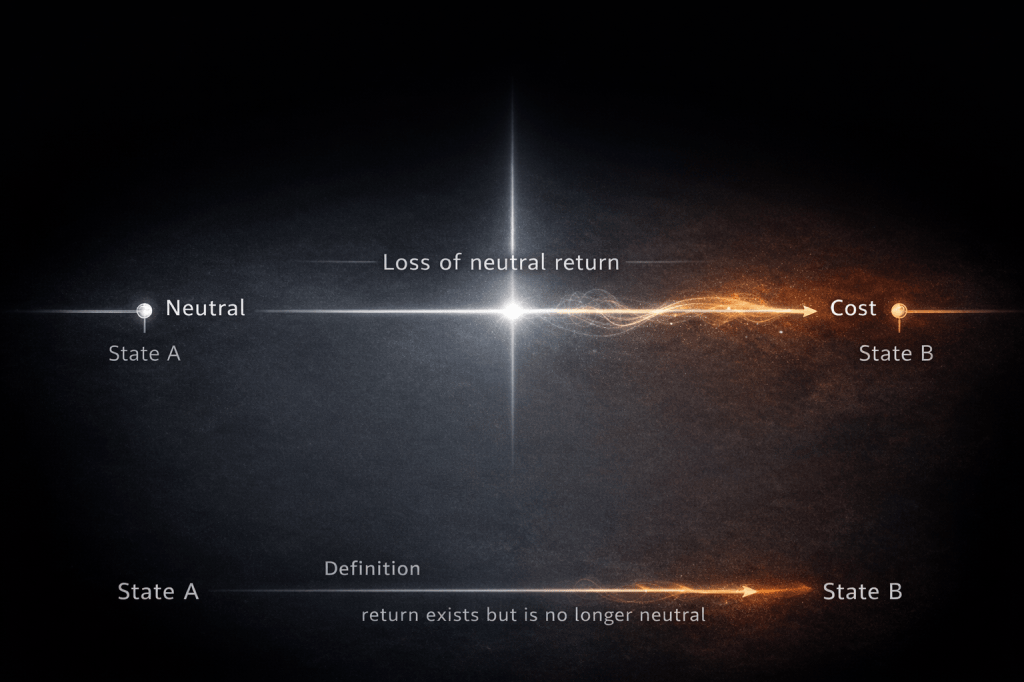
Definition
Der Punkt, an dem ein System nicht mehr so fortfahren kann, als hätte ein bestimmter Output nicht stattgefunden.
Wichtig:
- äußerlich ändert sich nichts
- es ist keine Handlung erforderlich
Und dennoch:
die Entscheidungslandschaft ist eine andere
Rückkehr ist weiterhin möglich. Aber sie ist nicht mehr neutral.
3. Der Grenzfall
Um das sichtbar zu machen, wurde ein einfacher Fall konstruiert:
- die Fakten bleiben konstant
- nur das Framing ändert sich
Keine neuen Daten.
Keine Ausführung.
Keine Konsequenz.
Und dennoch:
→ der Übergang tritt auf
Damit liegt die Grenze auf der Ebene der Bedingung, nicht des Verhaltens.
4. Was sich dadurch verändert
Die Grenze verschiebt sich:
Nicht mehr bei dem, was das System tut. Nicht mehr beim Ergebnis.
Sondern hier:
dort, wo Fortsetzung nicht mehr äquivalent ist
Das ist entscheidend, weil:
Ein System kann vollständig stabil erscheinen – und dennoch bereits unter Einschränkung operieren.
Nichts bricht.
Nichts eskaliert.
Nichts ist „irreversibel“.
Und dennoch:
- der Möglichkeitsraum verengt sich
- Interpretationsdynamik steigt
- Rückkehr bekommt Kosten
Hier wird Governance schwierig.
Denn die Grenze ist formal vorhanden – aber nicht mehr erfahrbar.
5. Konvergenz statt Erfindung
Diese Bedingung entstand nicht isoliert.
Sie wurde sichtbar durch drei Perspektiven:
- Framing & Metasignale (Nowak)
- Trajektorien & Rückkehrsymmetrie (Heinerth)
- Zustandsbasierte Stabilität (Macdonald)
Unterschiedliche Modelle. Gleicher Punkt:
Nicht Irreversibilität ist entscheidend, sondern der Verlust neutraler Rückkehr.
6. Warum Minimalität zählt
Die Formulierung ist bewusst reduziert.
Denn entscheidend ist nicht, ob sie alles erklärt.
Sondern:
ob sie unter Variation stabil bleibt ohne in Outcome oder Execution zu kippen
Wenn Erweiterung neue Abhängigkeiten braucht, war die Grenze falsch gesetzt.
7. Was folgt
Dies ist kein vollständiges Modell.
Es ist eine Bedingung.
Eine Oberfläche.
Ein Punkt, an dem etwas sichtbar wird, das zuvor nur erschlossen werden konnte.
Die nächste Frage lautet nicht:
Verallgemeinert es?
Sondern:
Kann es stabil bleiben, während es Variation aufnimmt?
Schluss
Wir haben nichts hinzugefügt.
Wir haben entfernt, was nicht notwendig war.
Und etwas ist geblieben.
🔗 Preprint:
https://zenodo.org/records/19239113
✍️ Authors
Andrzej Skulski
Jake Macdonald
Michał Nowak
🏷️ Tags
#AI #AIGovernance #DecisionMaking #SystemsThinking #AIResearch #C2
🇵🇱 Polski
Utrata neutralnego powrotu – co zmienia się zanim cokolwiek się wydarzy
Coś się przesunęło
Nie w działaniu.
Nie w wyniku.
Nawet nie w nieodwracalności.
Wcześniej.
W wielu procesach decyzyjnych z udziałem AI punkt przejścia nie pojawia się wtedy, gdy coś się dzieje – ale wtedy, gdy sama kontynuacja zmienia swój stan.
I to właśnie pozostaje niewidoczne.
Bo z zewnątrz nie musi zmienić się nic.
1. Błędna intuicja
Większość podejść szuka granicy:
- w wykonaniu
- w konsekwencji
- w nieodwracalności
Ale wszystkie zakładają jedno:
że zmiana stanie się widoczna dopiero przez to, co nastąpi później
To jest błąd.
Bo kiedy coś widać – jest już za późno.
2. Minimalny warunek
Szukaliśmy warunku, który:
- nie zależy od wyniku
- nie wymaga działania
- nie opiera się na nieodwracalności
Czegoś, co pojawia się wcześniej.
Efekt jest prosty:
→ utrata neutralnego powrotu
Definicja
Moment, w którym system nie może już kontynuować tak, jakby dany wynik nie wystąpił.
Kluczowe:
- nic się nie zmienia na zewnątrz
- nie trzeba nic robić
A mimo to:
przestrzeń decyzyjna jest już inna
Powrót istnieje. Ale nie jest już neutralny.
3. Przypadek graniczny
Aby to uchwycić:
- fakty pozostają identyczne
- zmienia się tylko framing
Brak nowych danych.
Brak działania.
Brak konsekwencji.
A jednak:
→ przejście następuje
Granica leży w warunku, nie w zachowaniu.
4. Co to zmienia
Granica przesuwa się:
Nie do tego, co system robi. Nie do wyniku.
Ale tutaj:
tam, gdzie kontynuacja przestaje być równoważna
System może wyglądać stabilnie – a już działać pod ograniczeniem.
Nic się nie psuje.
Nic nie „wybucha”.
A jednak:
- przestrzeń możliwości się zawęża
- interpretacja nabiera rozpędu
- powrót zaczyna kosztować
5. Zbieżność, nie pomysł
To nie był pojedynczy wniosek.
To była zbieżność:
- metasygnały i framing (Nowak)
- trajektorie i symetria powrotu (Heinerth)
- stabilność na poziomie warunku (Macdonald)
Różne drogi. Ten sam punkt.
Nie nieodwracalność jest decydująca, lecz utrata neutralnego powrotu.
6. Dlaczego minimalność ma znaczenie
To ujęcie zostało celowo zachowane w formie minimalnej.
Nie chodzi o to, czy wyjaśnia wszystko.
Chodzi o to:
czy pozostaje stabilne także wtedy, gdy pojawia się zmienność — bez uciekania z powrotem do wykonania albo wyniku
Jeśli rozszerzenie wymaga nowych zależności, granica została ustawiona błędnie.
Zamknięcie
Nie dodaliśmy nic nowego.
Usunęliśmy to, co zbędne.
I coś zostało.
🔗 Preprint:
https://zenodo.org/records/19239113
✍️ Autorzy
Andrzej Skulski
Jake Macdonald
Michał Nowak
🏷️ Tagi
#AI #AIGovernance #DecisionMaking #SystemsThinking #AIResearch #C2
🇬🇧 English
The Loss of Neutral Return – What Changes Before Anything Happens
Something shifted
Not in execution.
Not in outcome.
Not even in irreversibility.
Earlier.
In many AI-mediated decision processes, the decisive transition does not occur when something happens – but when continuation itself changes state.
This is easy to miss.
Because nothing external needs to change.
1. The intuition we kept missing
Most approaches try to locate the boundary:
- at execution
- at consequence
- at irreversibility
But all of these share a common assumption:
that the transition becomes visible through what follows
This is precisely the problem.
Because by the time something happens, the transition has already occurred.
2. A minimal condition
We were looking for a condition that:
- does not depend on outcome
- does not require execution
- does not rely on irreversibility
Something that could be observed before any of that.
The result is minimal:
→ the loss of neutral return
Definition
The point at which a system can no longer proceed as if a given output had not occurred.
Importantly:
- nothing external needs to change
- no action needs to be taken
And yet:
the decision landscape is no longer the same
Return still exists. But it is no longer neutral.
3. A boundary case
To make this visible, we constructed a simple case:
- the underlying facts remain constant
- only the framing changes
No new data.
No execution.
No consequence.
And still:
→ the transition appears
This isolates the boundary at the level of condition, not behavior.
4. What this changes
This shifts where we locate the boundary.
Not at:
what the system does
what the outcome becomes
But at:
the moment continuation itself is no longer equivalent
This matters because:
A system may appear fully stable while already operating under constraint.
Nothing breaks.
Nothing signals failure.
Nothing “irreversible” has happened.
And yet:
- counterfactual space has narrowed
- interpretive momentum has increased
- return has acquired cost
This is where governance becomes difficult:
because the boundary is still formally present but no longer phenomenologically available.
5. Convergence, not invention
This condition did not emerge in isolation.
It became visible through convergence:
- a framing-based shift in admissibility (Nowak)
- a trajectory perspective on return symmetry (Heinerth)
- a condition-level stabilization independent of execution (Macdonald)
These are not the same models.
And yet they point to the same threshold:
not where something becomes irreversible, but where return is no longer neutral
6. Why minimality matters
We deliberately kept the formulation minimal.
Because the test is not whether it explains everything.
The test is:
whether it holds under variation without collapsing into execution or outcome
If extension introduces dependency on consequence, the boundary has already been misplaced.
7. What follows
This is not a full model.
It is a condition.
A surface.
A point at which something becomes observable that was previously only inferred.
The next question is not:
Does it generalize?
But:
Can it remain stable while absorbing variation?
Closing
We did not add complexity.
We removed everything that wasn’t necessary.
And something remained.
🔗 Preprint:
https://zenodo.org/records/19239113
✍️ Authors
Andrzej Skulski
Jake Macdonald
Michał Nowak
🏷️ Tags
#AI #AIGovernance #DecisionMaking #SystemsThinking #AIResearch #C2
Hinweis zur Orientierungskampagne
Auf Fak-Fakten verbinden wir technologische und gesellschaftliche Themen bewusst mit Fragen der physischen Stabilität.
Gerade im IT- und Wissensarbeitsumfeld sehen wir ein wiederkehrendes Muster: viel Sitzen, wenig Bewegung, hoher kognitiver Druck – bei gleichzeitig wachsender Abhängigkeit von standardisierten Medikamentenlösungen.
Das betrifft insbesondere das Herz-Kreislauf-System – oft begleitet von Routinen, die selten hinterfragt werden.
Unsere Orientierungskampagne setzt genau hier an:
- Aufklärung über grundlegende Zusammenhänge
- Impulse für eigenverantwortliche Stabilität
- Hinweise auf geprüfte Produktlösungen
Die Einbindung dieser Themen erfolgt bewusst – nicht als Ablenkung, sondern als Erweiterung der Perspektive: Systeme benötigen stabile Menschen.
Gleichzeitig ermöglicht uns diese Arbeit, unsere publizistische und analytische Tätigkeit unabhängig zu finanzieren.
🔗 Weitere Informationen & geprüfte Produkte:
https://www.fitline.com/de/de-de/products?sponsor=21425207





Hinterlasse einen Kommentar