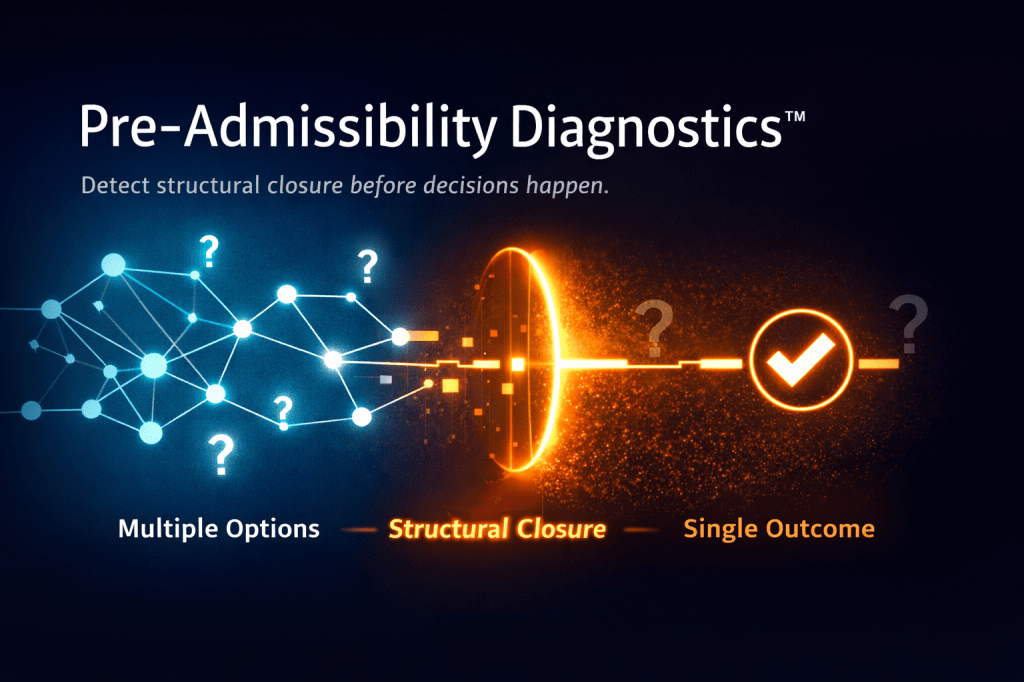
Pre-Admissibility Diagnostics™
Detect structural closure before decisions happen.
Most decision systems are evaluated too late.
They are checked for output quality, prediction accuracy, explainability, or consistency.
But one decisive question usually remains unasked:
👉 Is the decision space still genuinely open — or has it already been structurally closed before evaluation begins?
The hidden risk
Many assume that if a system is:
- consistent,
- data-driven,
- transparent,
- and able to generate alternatives,
then the underlying decision architecture must still be sound.
But this is often not the case.
A system can appear open while already operating inside a narrowed space of possibilities.
At that point:
- options still appear,
- variation still exists,
- decisions still seem active,
while in reality:
👉 relevant alternatives no longer emerge at all.
What traditional diagnostics miss
Standard evaluation typically focuses on what is visible:
- Which option was selected?
- How accurate was the prediction?
- How diverse were the generated alternatives?
- How explainable is the system’s reasoning?
These are important questions.
But they all assume that the decision space itself is still admissible.
Pre-Admissibility Diagnostics™ addresses the layer before that.
What we examine
1. Structural Admissibility
Are relevant alternatives still able to emerge at all?
2. Constraint Provenance
Which priors, assumptions, training conditions, business logics, or contextual rules have already shaped the space?
3. Non-Emergence Detection
What is absent — not because it was rejected, but because it never appeared?
4. Boundary Conditions
At which point does a system move from open decision support into structurally pre-shaped execution?
Why this matters
Without this layer, organizations risk:
- optimizing within invisible constraints,
- mistaking consistency for openness,
- treating reduced option spaces as good governance,
- and discovering too late that the decision was already made by the structure itself.
Not when the decision space has already been narrowed in advance.
Typical signals of structural closure
- the same classes of recommendations recur under different surface conditions
- counterfactuals vary internally, but never break the same boundary assumptions
- high coherence coexists with low strategic novelty
- human decision-makers still “choose,” but only within a pre-shaped frame
- governance reviews outputs, while decisive constraints remain upstream and untouched
Who this is for
- Predictive Intelligence environments
- AI Governance & Compliance teams
- Executive decision systems
- Strategy, risk, and transformation leaders
- Organizations working with human–AI decision architectures
Service formats
Diagnostic Sprint
2–3 weeks
A focused review of one defined decision environment.
- problem framing
- structural closure analysis
- short written diagnostic summary
Starting from €2,500
Executive Audit
3–5 weeks
A deeper review of a decision system or predictive architecture.
- admissibility risks
- constraint mapping
- decision-space integrity review
- executive summary + recommendations
Starting from €5,000
Architecture Review
Custom scope
For organizations that want to embed this layer into governance, risk, or system design.
Core distinction
| Standard evaluation | Pre-Admissibility Diagnostics™ |
| Measures outputs | Examines conditions of emergence |
| Tracks visible variation | Detects invisible closure |
| Optimizes inside the space | Questions whether the space is still open |
| Focuses on performance | Focuses on admissibility |
The key question
Contact
If this question matters in your organization, we can review one concrete case in writing first.
📩 Contact via email
or via LinkedIn
Dom Ciszy – Resonanzlabor Moormerland
Admissibility before execution