
🇩🇪 Deutsch
Was, wenn unsere Begriffe mehr über uns sagen als über die Vergangenheit?
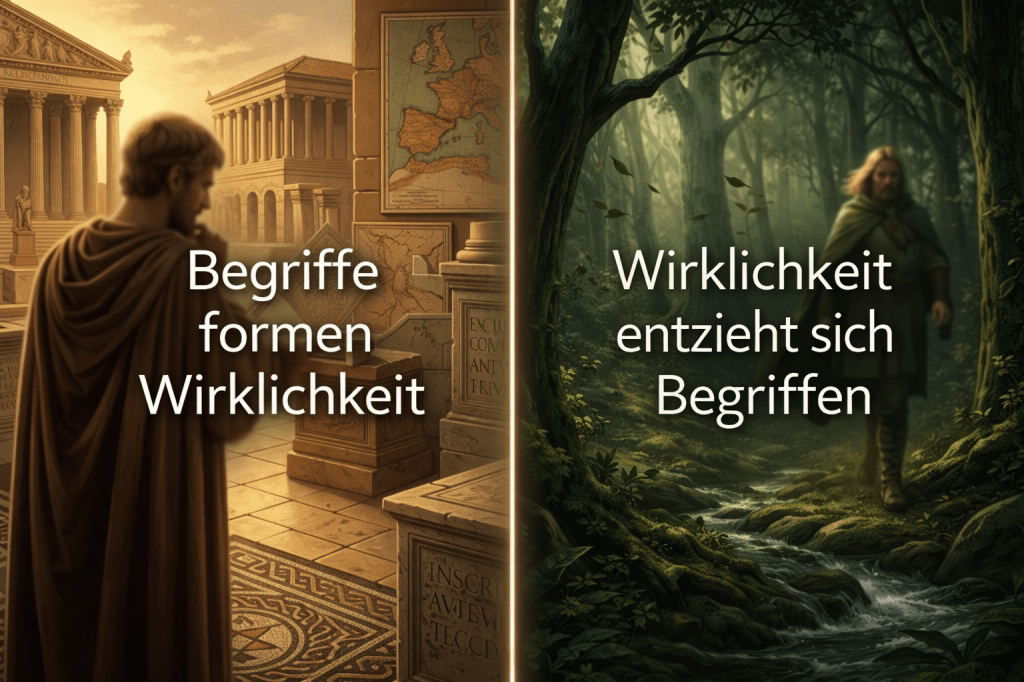
Begriffe beschreiben nicht nur Realität.
Sie entscheiden, was überhaupt sichtbar wird.
Die römisch-germanische Kontaktzone gilt seit Jahrzehnten als klassisches Forschungsfeld.
Wir sprechen über Austausch, Einfluss, Integration oder „Romanisierung“.
Doch je länger man sich damit beschäftigt, desto klarer wird:
Diese Begriffe beschreiben nicht nur Wirklichkeit.
Sie erzeugen sie.
Denn Begriffe sind nie neutral.
Sie strukturieren Wahrnehmung, setzen Rahmen und definieren, was sichtbar wird — und was nicht.
Genau hier entsteht ein Problem, das weit über die Antike hinausgeht.
Die eigentliche Frage ist nicht nur:
Was berichten die Quellen?
sondern:
Wie berichten sie — und mit welchen Begriffen?
Römische Texte sind keine neutralen Informationsspeicher.
Sie sind Teil eines Systems, das die „germanische Welt“ nicht nur beschreibt, sondern gleichzeitig formt.
Und genau diese Logik wirkt bis heute:
Wir übernehmen Begriffe.
Wir wiederholen Kategorien.
Wir reproduzieren Perspektiven.
Oft, ohne es zu bemerken.
Das bedeutet:
Wenn wir über Geschichte sprechen, sprechen wir nie nur über Vergangenheit.
Wir sprechen immer auch über die Strukturen, mit denen wir Wirklichkeit ordnen.
Und vielleicht liegt genau darin die Verbindung zur Gegenwart:
Auch heute entstehen „Realitäten“ durch Begriffe, Modelle und Systeme, die festlegen, was überhaupt noch denkbar ist.
Deshalb reicht es nicht, Inhalte zu analysieren.
Wir müssen die Begriffe hinterfragen, mit denen wir sie überhaupt erst sichtbar machen.
(aus aktueller Arbeit zur römisch-germanischen Kontaktzone — Schnittstelle von Diskursanalyse, Terminologie und Wahrnehmung)
🇵🇱 Polski
Co jeśli nasze pojęcia mówią więcej o nas niż o przeszłości?
Pojęcia nie tylko opisują rzeczywistość.
One decydują o tym, co w ogóle staje się widoczne.
Rzymsko-germańska strefa kontaktu od dziesięcioleci uchodzi za klasyczne pole badań.
Mówimy o wymianie, wpływie, integracji czy „romanizacji”.
Jednak im dłużej się temu przyglądamy, tym wyraźniej widać:
Te pojęcia nie tylko opisują rzeczywistość.
One ją wytwarzają.
Ponieważ pojęcia nigdy nie są neutralne.
Strukturyzują percepcję, wyznaczają ramy i definiują, co staje się widoczne — a co nie.
W tym miejscu pojawia się problem, który wykracza daleko poza starożytność.
Prawdziwe pytanie nie brzmi tylko:
Co mówią źródła?
lecz:
W jaki sposób mówią — i jakimi pojęciami?
Teksty rzymskie nie są neutralnymi nośnikami informacji.
Są częścią systemu, który nie tylko opisuje „świat germański”, ale jednocześnie go kształtuje.
I ta logika działa do dziś:
Przejmujemy pojęcia.
Powtarzamy kategorie.
Odtwarzamy perspektywy.
Często, nie zdając sobie z tego sprawy.
To oznacza:
Gdy mówimy o historii, nigdy nie mówimy wyłącznie o przeszłości.
Mówimy również o strukturach, za pomocą których porządkujemy rzeczywistość.
I być może właśnie tutaj pojawia się połączenie z teraźniejszością:
Także dziś „rzeczywistości” powstają poprzez pojęcia, modele i systemy, które określają, co w ogóle jest jeszcze możliwe do pomyślenia.
Dlatego nie wystarczy analizować treści.
Musimy kwestionować pojęcia, dzięki którym te treści w ogóle stają się widoczne.
(z aktualnych badań nad rzymsko-germańską strefą kontaktu — na styku analizy dyskursu, terminologii i percepcji)
🇬🇧 English
What if our concepts tell us more about ourselves than about the past?
Concepts do not merely describe reality.
They determine what becomes visible in the first place.
The Roman–Germanic contact zone has long been considered a classical field of research.
We speak of exchange, influence, integration, or “Romanization”.
Yet the longer one engages with it, the clearer it becomes:
These concepts do not simply describe reality.
They produce it.
Because concepts are never neutral.
They structure perception, set frames, and define what is visible — and what is not.
This is where a problem emerges that goes far beyond antiquity.
The real question is not only:
What do the sources report?
but:
How do they report — and with which concepts?
Roman texts are not neutral repositories of information.
They are part of a system that not only describes the “Germanic world”, but actively shapes it.
And this logic persists today:
We adopt concepts.
We repeat categories.
We reproduce perspectives.
Often without even noticing it.
This means:
When we speak about history, we never speak only about the past.
We also speak about the structures through which we organize reality.
And perhaps this is precisely where the connection to the present lies:
Even today, “realities” emerge through concepts, models, and systems that define what can still be thought at all.
Therefore, it is not enough to analyze content.
We must question the concepts that make these contents visible in the first place.
(from ongoing research on the Roman–Germanic contact zone — at the intersection of discourse analysis, terminology, and perception)





Kommentar verfassen